
DBS Survey Finds 88% of Businesses Testing or Using Tokenized Money

 Prefer us on Google


TL;DR: A DBS survey published October 28 found that 88% of businesses in its sample were deploying or piloting tokenized-money use cases. Crypto traders sometimes treat institutional survey results as proof that public token demand must surge.
A DBS survey published October 28 found that 88% of businesses in its sample were deploying or piloting tokenized-money use cases. The Singapore bank presented the results as evidence of growing interest in round-the-clock money movement, better liquidity management and expansion across trading corridors. Respondents also reported reworking treasury and finance processes against a backdrop of shifting supply chains. The headline percentage combines testing with deployment; it does not mean that 88% of large companies have replaced their traditional bank accounts with stablecoins.
The event and the market response
The survey connects tokenized money to a set of practical corporate needs. A multinational business may need to move funds among subsidiaries, pay suppliers in different currencies or reconcile balances after local payment systems have closed. Tokenized deposits and stablecoins can be evaluated for particular parts of those tasks, but successful treasury integration requires approvals, liquidity, accounting and reliable conversion to conventional balances. The bank also reported that more than three quarters of respondents expected AI to improve treasury, payment or collection operations over the next two years.
Why the development matters to the crypto market
Crypto traders sometimes treat institutional survey results as proof that public token demand must surge. That conclusion is too quick. Corporations may adopt privately operated payment systems or bank-issued tokenized deposits without taking directional exposure to volatile cryptocurrencies. The stronger market implication is demand for dependable settlement services and stable-value balances. Investors should ask which networks are actually used, how much real value they carry and whether adoption persists beyond early experiments.
An institutional buyer will evaluate the cost of connecting a new rail to its existing systems before celebrating the technology. That includes identity checks, transaction reporting, asset servicing, reconciliation and recovery procedures when something goes wrong. A smaller but repeatable workflow can be commercially more valuable than an enormous theoretical market size. In this case, progress should be measured against the promised operational improvement and the conditions attached to it. Without usage figures, no one can reliably turn a partnership or infrastructure milestone into a forecast of investment returns.
Tokenized finance is often described as a single market, but it covers quite different instruments: cash-like balances, securities, private credit and other claims. Each has different settlement and counterparty risks. Institutional adoption becomes meaningful when service providers can explain who owes what, how a holder exits a position and what happens during a dispute. The detail matters as much as speed. A sound launch can be the beginning of a larger change, although the step from successful integration to widespread, economically useful activity is rarely automatic.
What the headline does not establish
Survey evidence requires attention to definitions and sampling. A pilot can be a limited experiment, while live deployment might serve only a small fraction of a company's transactions. Firms may also mean different things by tokenized money, including privately issued bank liabilities, stablecoins and representations of deposits. DBS has a commercial role in the financial-services market it is analyzing, making the methodological details especially important. The finding is useful as a measure of reported interest, but less informative than independently verified volumes and operating savings.
-- Price
What to watch next
The next useful disclosures would break out pilots from production deployments, distinguish stablecoins from tokenized deposits and report measurable savings or settlement volumes. Those would help establish whether strong survey interest is becoming large-scale use.
Primary source: Official statement / source documentation.
written by the News Desk and edited by Samuel Rae.
This content is provided for general informational purposes only and doesn't constitute financial, investment, legal, or tax advice. Any events, rewards, online promotions, or related information mentioned herein should not be considered a recommendation, solicitation, or invitation to purchase, sell, trade, or otherwise deal in any crypto assets. Crypto assets are highly volatile and may result in loss. The availability of WEEX services, products, and related events may vary by region. You are responsible for ensuring that your participation is in accordance with applicable local laws and regulations.
You may also like
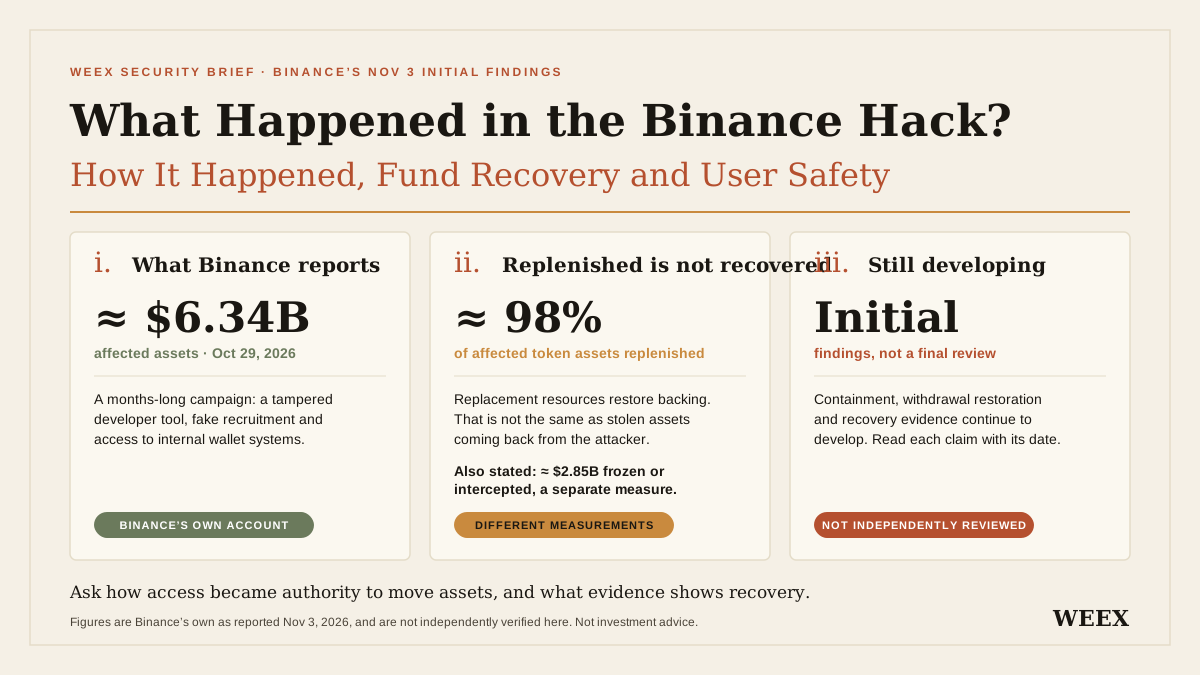
What Happened in the Binance Hack? How It Happened, Fund Recovery and User Safety
What happened in the Binance hack? Review the attack timeline, latest fund replenishment, recovery limits and practical steps to protect your account.

CPI Higher Than Expected in the U.S.: What It Means for Investors
Crypto ATM Fees: How Much Bitcoin (BTC) Do You Get for $100?
See how much Bitcoin $100 buys at a crypto ATM. Compare two sample quotes, calculate the all-in cost, and learn which fees not to count twice.

Stablecoins: French People Stock Up on Self-Custody According to Chainalysis

Datachain Supports Mitsui Sumitomo Bank's On-Chain Financial Infrastructure Technology Review
Poland's Parliament Votes 240-202 To Let Officials Freeze Crypto Before Court Review

Visa adds Monad as stablecoin settlement run rate tops $25B

Algorithmic Trading and Cryptocurrencies: How Do Robots React to Volatility?
Cryptocurrency Anarchism Lacks Commitment, Coordination, and Reputation, Not New Tokens

Enza Closes $6 Million Funding Round to Develop Payment Infrastructure

Financial Commission to Manage Stock Market Volatility with Sidecars and High-Frequency Trading Checks

Solana's Former DEX Leader Prepares to Go All In on US Stocks
U.S. DOJ files for forfeiture of 456602 USDT linked to romance scams

Dunamu Vice Chairman Kim Hyung-nyeon Completes Tokenized Stock Technology Preparation and Expects Regulatory Approval

Bitso Business Says Stablecoin Payment Volume Now Runs Above $150B Annualized

ICE Investment, L2 Launch, and 1000x Leverage Mechanism: The Iterative Path of Hyperliquid's On-Chain Finance

Broadridge Says Blockchain Repo Platform Processed $7.6T in October
Coldcard’s $116M exploit sparks fresh clash over NVK’s defense

FATF Plans Closer Scrutiny of Countries With Weak Virtual Asset Controls

Red Code: Why Your Bitcoin Depends on Other People's Debts for AI

Formation Files with SEC to Operate Tokenized Securities Trading Venue on Solana
Why Wall Street can use Ethereum without betting on ETH
Polygon wants to move 70 million POL without the wallet holders’ signatures

Real Buyers or Internal Transfers? A Review of This Week's Nine Major Token Movements to Help You Identify False Whale Narratives

Did Strategy buy Bitcoin? Saylor reignites speculation

DTCC Launches Tokenization Service: What Can Investors Actually Do?

A New Chapter in the History of Rug Pulls in Crypto
Gopax Halts Operations Amid Hacking Threats, Binance Breached: A Test for Exchange Security

Hut 8 Expands AI Campus Commitments While Funding Buybacks With Bitcoin Sales

Vitalik Buterin Believes Slowing Down Computing Power Expansion is More Beneficial than Harmful
What Happened in the Binance Hack? How It Happened, Fund Recovery and User Safety
What happened in the Binance hack? Review the attack timeline, latest fund replenishment, recovery limits and practical steps to protect your account.
CPI Higher Than Expected in the U.S.: What It Means for Investors
Crypto ATM Fees: How Much Bitcoin (BTC) Do You Get for $100?
See how much Bitcoin $100 buys at a crypto ATM. Compare two sample quotes, calculate the all-in cost, and learn which fees not to count twice.
Stablecoins: French People Stock Up on Self-Custody According to Chainalysis
Datachain Supports Mitsui Sumitomo Bank's On-Chain Financial Infrastructure Technology Review
Poland's Parliament Votes 240-202 To Let Officials Freeze Crypto Before Court Review
Latest articles




Latest coin listings on WEEX


