
Circle Shareholders and Sun Yuchen File Lawsuits Amid Ongoing Controversy Over Trump's Family Crypto Business WLFI

 Prefer us on Google


On October 22, J. Benjamin Greenberg, a shareholder of Circle, the issuer of the US dollar stablecoin USDC, filed a lawsuit against U.S. President Donald Trump.
The defendants also include Trump's family crypto company World Liberty Financial (WLFI). The plaintiff claims that two transactions involving entities related to the United Arab Emirates violate the foreign emoluments clause in the Constitution and harm Circle's business interests.
The two transactions involved amounts of $500 million and $2 billion, both linked to institutions associated with UAE National Security Advisor Tahnoon bin Zayed Al Nahyan. Meanwhile, WLFI's stablecoin USD1 has just received preliminary approval for a national trust bank license. One path leads to the courts, while the other leads to regulatory agencies, with USD1 simultaneously under scrutiny from both.
The Two Transactions
The lawsuit was filed by Greenberg in federal court on behalf of Circle. In addition to Trump and WLFI, the defendants include WLFI's parent company and U.S. Middle East envoy Steve Witkoff. The plaintiff's demands include recovering related profits, disclosing other foreign cryptocurrency payments received by Trump, and seeking damages.
The two transactions targeted in the lawsuit involve different types of money.
The first is an equity transaction. Just days before Trump took office in January 2025, the Abu Dhabi entity Aryam Investment 1 signed a contract to purchase 49% of WLFI for $500 million. This entity is backed by UAE National Security Advisor Tahnoon bin Zayed Al Nahyan. According to the Wall Street Journal, the initial payment was $250 million, of which approximately $187 million flowed to Trump family entities, and at least $31 million went to entities associated with Witkoff. The agreement was signed by Eric Trump. Reports indicate that WLFI had not yet launched any products at that time.
The second is a stablecoin settlement. The Abu Dhabi fund MGX, chaired by Tahnoon, announced in March that it would invest $2 billion in Binance. On May 1, Eric Trump publicly stated that this investment would be settled in USD1. The lawsuit lists this $2 billion investment settled in USD1 as one of the relevant transactions. Binance CEO Richard Teng previously stated that settling in USD1 was MGX's decision and that Binance did not provide any preferential treatment.
However, obtaining an institutional order for USD1 does not alone prove that Circle would have originally secured this business, nor does it imply that Circle lost a $2 billion business. The issue of commercial damage and its causation remains a challenge the lawsuit must confront.
Disassociating
Reports indicate that Greenberg is a former software engineer at Circle, holding about 10,000 shares, and is suing in the company's name. The competitive argument in the lawsuit is that WLFI used these foreign funds to grow USD1, taking business that should belong to Circle.
In response, Circle has made it clear that this lawsuit was initiated by a shareholder personally, and the company did not initiate, direct, authorize, or participate in it.
WLFI's response was direct. A spokesperson stated that the lawsuit is "baseless," asserting that the company complies with all U.S. laws and that no one at WLFI holds a position in the U.S. government. Their lawyer described it as a "partisan press release" that is "unfounded." The company has also stated that Trump was not involved in this equity transaction and currently holds no position in the project.
Qualification is the First Hurdle
Such lawsuits are not new.
Since 2017, lawsuits regarding foreign emoluments related to Trump's hotel business have emerged, with plaintiffs including Washington's ethics watchdog, the attorneys general of Maryland and Washington, D.C., and nearly 200 Democratic lawmakers. Most cases have stumbled at the same threshold: what specific harm did the plaintiffs suffer, and do they have standing to sue? Some courts have found standing, while appellate courts have overturned those decisions.
This time, the plaintiff is a small shareholder from a competitor, and the approach has changed: instead of claiming public interest, they are claiming business losses. Circle, on whose behalf he is asserting rights, has publicly distanced itself, and whether the judge is willing to accept this route is the first hurdle of the entire lawsuit.
The Second Plaintiff
Circle's shareholder is not the only one suing WLFI.
In April 2026, Justin Sun, founder of TRON, filed a lawsuit against WLFI in federal court in California. According to Reuters, his lawsuit indicates that he invested $45 million in WLFI. He claims that his tokens were frozen due to WLFI blacklisting his wallet containing over 500 million tokens in September 2025. He also alleges that WLFI pressured him to issue and promote USD1 on TRON, and after he refused, he faced retaliation.
WLFI denies these allegations. Witkoff publicly responded, stating that this is Sun's way of diverting attention from his own misconduct.
Recently, in a conversation with Jin Ming, he characterized this lawsuit as "business to business," asserting that he continues to support Trump's crypto policies and AI strategy, maintaining a strong position in U.S. stocks, and that the lawsuit is merely a way for investors to protect their rights. He also mentioned that even if the agreement's value involves $400 to $500 million, it does not significantly impact his overall assets.
The allegations in the two lawsuits differ. Sun's focuses on governance and token freezing, while Circle's shareholder targets the source of funds. However, both lawsuits encounter the question of how USD1 reaches large funds and platforms: one claims someone was pressured to promote USD1 on TRON, while the other points to the $2 billion settlement via Binance.
Beyond the License
On August 14, the Office of the Comptroller of the Currency (OCC) granted preliminary conditional approval for World Liberty Trust Company's national trust bank license application. The company still needs to meet relevant conditions and complete pre-opening regulatory requirements to obtain final approval. Such trust banks generally cannot accept deposits or issue loans like commercial banks. Once approved, it will take over the issuance and reserve custody of USD1 from BitGo. Circle has also previously received preliminary conditional approval for a similar license application.
During the review period, the OCC received opinions regarding conflicts of interest involving UAE investors, the Trump family, and the foreign emoluments clause. The approval letter determined that these foreign investors are not the primary shareholders of the bank and received passive holding commitments from several investors, promising not to seek control or influence over the bank's operations and decisions, with Eric Trump signing on behalf of an investment entity. The OCC viewed the questions regarding conflicts of interest and the foreign emoluments clause as outside the scope of the license review and noted that WLFI itself is not the subject of this application.
This license review did not make a judgment on whether the foreign emoluments clause was violated.
One of Circle's past competitive advantages has been its compliance qualifications, including obtaining regulatory approval earlier. With WLFI receiving preliminary approval, this gap has narrowed at the licensing level. The Circle shareholder's lawsuit lists this approval as one of the government decisions that may benefit the Trump family and extends the controversy to the relationship between foreign funds and the Trump family's business interests.
In February, two Democratic senators on the Senate Banking Committee wrote to the Treasury Secretary, asking him to determine whether the $500 million investment by UAE-related investors to acquire approximately 49% of WLFI's equity required review by the Committee on Foreign Investment in the United States (CFIUS) for national security and to conduct a review if applicable. Additionally, Democratic representatives in the House have pushed for an investigation into this equity transaction.
The court must first determine whether the plaintiff has standing, and the OCC has already excluded the foreign emoluments clause from the license review scope. The investigations and review requests raised by Democratic lawmakers in Congress have not yet yielded conclusions.
Currently, the issues arising from equity investments and stablecoin settlements remain unanswered: capital associated with the UAE has purchased equity in a Trump family-related enterprise, while another $2 billion investment directed at Binance has been settled in USD1. When foreign funds intersect with the commercial interests of a presidential family and U.S. financial infrastructure, who will examine the potential impacts of these relationships under existing laws and regulatory mechanisms?
This article is for informational purposes only and does not constitute any investment advice. The market carries risks, and investment should be approached with caution.
-- Price
This content is provided for general informational purposes only and doesn't constitute financial, investment, legal, or tax advice. Any events, rewards, online promotions, or related information mentioned herein should not be considered a recommendation, solicitation, or invitation to purchase, sell, trade, or otherwise deal in any crypto assets. Crypto assets are highly volatile and may result in loss. The availability of WEEX services, products, and related events may vary by region. You are responsible for ensuring that your participation is in accordance with applicable local laws and regulations.
You may also like

XRPL lending protocol gains validator support as vault vote advances

US card debt hits $1.29 trillion as Bitcoin loans expose a collateral divide

CryptoQuant: Bitcoin Analyst Sentiment Significantly Bearish, Index Drops to -1.8σ

How Much CPO Demand Will NVIDIA's Rubin Ultra Generate? Bernstein: Optical Value of Single Pod Increases Fivefold

Pump.fun Data Review: Why the Current Meme Market Has Become a 'Harvesting Game'?

As Protocols Move Back to the Mainnet, How Does Ethereum's Value Logic Change?

As Whales Embrace ETFs, Security Anxiety in the Crypto World is Spreading
How Much Revenue Can Anthropic Generate for Every $1 Spent on Computing Power?

WEEX 11.11 Shopping Fest: Buy BTC and Unlock Up to 888 USDT in Rewards

Bitget UEX Daily Report | Inflation Surprises and Pressures US Stocks; Nvidia Falls Over 5%; Gold Drops Below $4100 (November 11, 2026)

How Much Net Buying Power Will ETH Lose When Bitmine Stops Buying?
LlamaRisk Proposes to Narrow Aave V3 Core Collateral Asset Range, Involving $1.33 Billion in Collateral

Algorithmic Trading and Cryptocurrencies: How Do Robots React to Volatility?

Cardano’s police evidence system could bring 1.5 million annual transactions

Confidence at Zero! Goldman Sachs Interprets Hedge Fund Positions: 'Surrender Liquidation', Largest Loss Since the Pandemic
47% Top Tax Rate Approaches: Seven Tax Reduction Strategies for Australian Crypto Investors
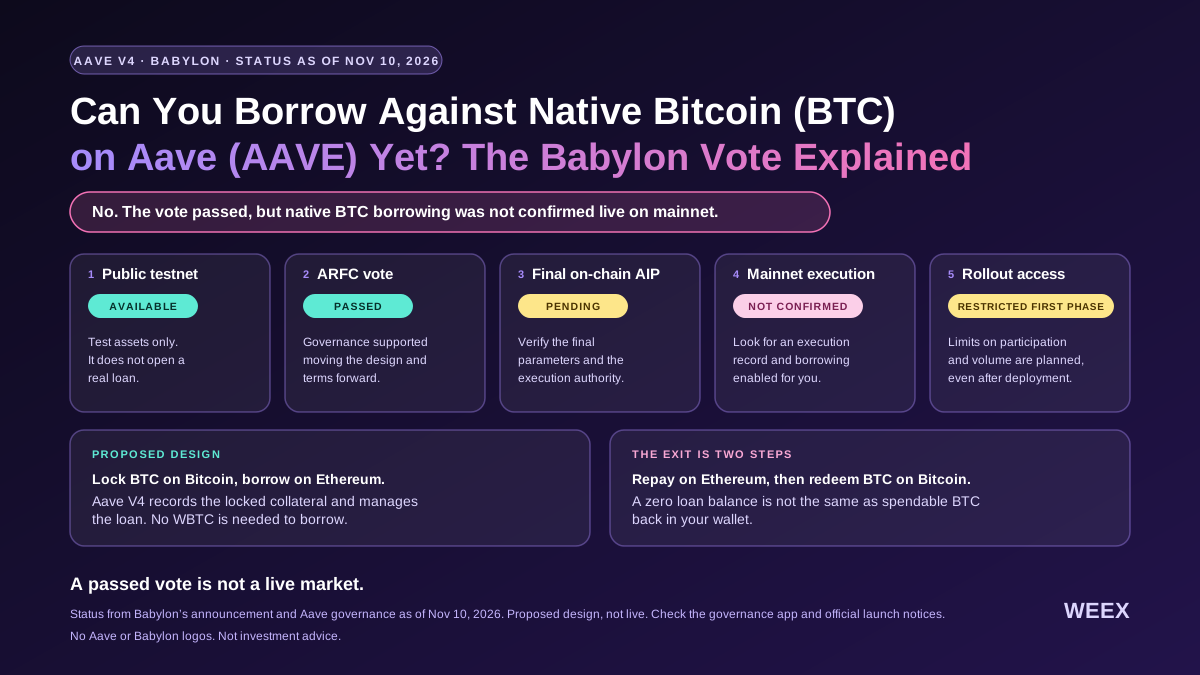
Can You Borrow Against Native Bitcoin (BTC) on Aave (AAVE) Yet? The Babylon Vote Explained
Can you borrow against native Bitcoin on Aave yet? See what the Babylon vote approved, what still needs to launch, and how BTC liquidation would work.

PIEVERSE Price Up Nearly 80% in a Week: Futures Activity, the November 14 Unlock and What Is Confirmed
PIEVERSE rose about 79% in seven days with futures volume far above spot. See what is confirmed about the November 14 unlock and the WEEX Lucky Eggs campaign.
Hong Kong Approves Crypto Asset Reporting Rules - Fintech World

NVDA Stock Falls 4.3% After Board Opens Investigation: What Is Confirmed and What Is Not
NVDA closed at $178.67 on November 9, 2026, down about 4.3%, after Nvidia’s board confirmed an independent investigation. Other claims come from media reports. WEEX’s Lucky Eggs campaign runs until November 25.

Chainalysis Report: Why Did Western Europe Withstand the Global Crypto Market Chill?

Four Security Strategies from the Wallet Theft Incident

Global Outage: Your Cryptos Are Not Disappearing

Did Strategy buy Bitcoin? Saylor reignites speculation

A New Chapter in the History of Rug Pulls in Crypto

From Binance Incubator to Nasdaq: Injective's Eight Years

tBTC Cross-Chain Bridge Resumes On-Chain Operations, Threshold Network Confirms Adequate Reserves
FinCEN Withdraws Proposed Crypto Travel Rule Expansion in Separate November Move

Finnish Startup Uses Heat from Bitcoin Miners to Heat 30 Homes

Analysis: The Logic of BTC's Periodic Recovery Remains Unshaken, Losses and Panic Have Been Fully Released
XRPL lending protocol gains validator support as vault vote advances
US card debt hits $1.29 trillion as Bitcoin loans expose a collateral divide
CryptoQuant: Bitcoin Analyst Sentiment Significantly Bearish, Index Drops to -1.8σ
How Much CPO Demand Will NVIDIA's Rubin Ultra Generate? Bernstein: Optical Value of Single Pod Increases Fivefold
Pump.fun Data Review: Why the Current Meme Market Has Become a 'Harvesting Game'?
As Protocols Move Back to the Mainnet, How Does Ethereum's Value Logic Change?
Latest articles


Latest coin listings on WEEX


