
Cardano Spends 23.6 Million Francs, On-Chain Audit Confirmed

 Prefer us on Google

The Cardano Foundation has linked its 2025 activity and financial report with an external auditor's confirmation on the blockchain. The foundation's expenditure for 2025 amounted to 23.6 million Swiss francs, with assets totaling 287.5 million Swiss francs by the end of 2025.
In the 2025 activity and financial report released on April 2, 2026, the Cardano Foundation stated that it has disclosed financial information on-chain for two consecutive years through the financial reporting platform Reeve. The foundation explained that the audited financial statements were confirmed on-chain by Grant Thornton Switzerland/Liechtenstein.
The key aspect of this case goes beyond merely uploading financial figures to the blockchain. The foundation has bundled cryptographic records of financial data, corporate identity, and audit opinions into a single flow. The Grant Thornton case study revealed that it applied standard audit procedures to on-chain financial data by combining Reeve with a verifiable legal entity identifier (vLEI).
Pascal Furger, a partner at Grant Thornton Switzerland/Liechtenstein, stated in the case study, "The foundation's decentralized application has allowed direct access to Reeve financial data on Cardano alongside verified legal identifiers." The ability to verify transaction records and identity layers in one place has laid the groundwork for applying standard audit procedures.
Reeve is a platform that fixes financial data on the Cardano blockchain, enabling verification of any changes to the report's content. Typically, financial reporting involves separate documents and procedures for report files, audit opinions, and corporate identity verification. This approach can be seen as a case that narrows the connection to blockchain records and digital identity systems.
vLEI is a decentralized digital identity system that allows for the mechanical verification of the identity, authority, and role of a corporation and its representatives. The Global Legal Entity Identifier Foundation (GLEIF) explains that vLEI cryptographically combines corporate identity, personal identity, and roles within official organizations. The issue of on-chain accounting expands from "what has been recorded" to "who has verified it and with what authority."
The Cardano Foundation described this audit as "the world's first case" in its monthly update. However, this expression is based on the foundation's and the auditing firm's explanations. It is more appropriate to view it within the scope disclosed by the foundation in its official report and case study rather than independently determining whether it is the first in the entire industry.
The foundation's expenditure for 2025 was 23.6 million Swiss francs. As of December 31, 2025, assets totaled 287.5 million Swiss francs, composed of 51.6% ADA, 25.5% BTC, and 22.9% in cash, cash equivalents, and other financial assets. While on-chain audits can enhance reporting transparency, they do not reduce the inherent price volatility of the assets held.
The relationship with Grant Thornton is not a newly initiated collaboration. The Cardano Foundation announced the appointment of Grant Thornton as an external auditor on April 4, 2019. This on-chain audit confirmation is an extension of the existing audit relationship, integrating Reeve and vLEI to expand the verification methods of the audit process.
From a timeline perspective, the Cardano Foundation has been gradually expanding external data accessibility. Previously, the foundation increased governance data accessibility by disclosing proposal and voting data on Dune. This time, it has linked financial reporting and audit confirmation to blockchain records.
The implications differ for stakeholders. For the foundation, it is a means to enhance the verifiability of financial reporting, while for auditors, it is a case of applying existing audit procedures to blockchain-based materials. For ecosystem participants, the increased accessibility to information that allows tracking the foundation's assets and expenditure scale is more direct.
For domestic investors, this matter is perceived as a change in disclosure and audit infrastructure rather than a price-related material. The foundation's asset structure, heavily weighted in ADA and BTC, is influenced by token price fluctuations, but no figures have been presented indicating that this disclosure directly moved market prices. Therefore, the price impact remains an area to be verified separately.
Comments on Grant Thornton's LinkedIn post included opinions assessing the practical feasibility of on-chain accounting, as well as cautious views emphasizing that the identity layer and scalability are key rather than the immutability of records. There is an underlying recognition that merely leaving numbers on the blockchain does not complete accounting trust; the auditing entity and authority must also be verified.
This case demonstrates that blockchain accounting can extend beyond simple disclosure to include audit procedures and corporate identity verification. The Cardano Foundation presented an expenditure of 23.6 million Swiss francs and assets of 287.5 million Swiss francs in its 2025 report, while Grant Thornton publicly disclosed its audit confirmation method combining Reeve and vLEI as a case study.
-- Price
This content is provided for general informational purposes only and doesn't constitute financial, investment, legal, or tax advice. Any events, rewards, online promotions, or related information mentioned herein should not be considered a recommendation, solicitation, or invitation to purchase, sell, trade, or otherwise deal in any crypto assets. Crypto assets are highly volatile and may result in loss. The availability of WEEX services, products, and related events may vary by region. You are responsible for ensuring that your participation is in accordance with applicable local laws and regulations.
You may also like

OKX Star Points Out THORChain TSS + Validator Model Lacks Decentralization

Payward, the parent company of Kraken, invests billions in financial infrastructure

Bloomberg analyst warns 5% U.S. 10-year yield may reduce Bitcoin appeal

Shielded Bitcoin: the proposal that aims to bring privacy without changing BTC's code

What is CBDC? Governments Push for Development of Central Bank Digital Currencies

Backpack CEO Plans to Bring the Entire Stock Market to Solana

Use of Stablecoins Grew 75% in Bear Market
![[New York Gold, Bonds, Dollar] Interest Rates and Dollar Strength Pause... Oil Prices Drop, Won and Gold Prices Rebound](/public-static/29_4631d65680.png?format=avif)
[New York Gold, Bonds, Dollar] Interest Rates and Dollar Strength Pause... Oil Prices Drop, Won and Gold Prices Rebound

Polymarket partners with OpenWorlds on AI trading agents
Former New York Governor Cuomo: Tokenization Surpasses U.S. Regulation, Regulatory Clarity Affects Capital Flow

US-Iran Negotiations Signal Easing Energy Tensions, but Diesel Crisis Complicates Inflation Risks

Thailand Stock Market News: SET and NYSE Explore Dual Listings and New Investment Products

Compute Finance: The Financial Layer Being Built by the AI Economy, 0G is Constructing a New Paradigm for Computing Assets
Wall Street Legend Bill Miller: Why Did I Bet Half My Fortune on Bitcoin?

The Stronger the AI, the Lower the Wages: Your Education is Becoming the Most Expensive Devalued Asset

Oracle Stock vs. KRAFTON Stock: Why Are Investors Questioning Two Growing Companies?
Compare Oracle and KRAFTON stocks through their latest results, share-price questions and the different growth tests investors face in 2026.
What Happens When the AI Bubble Bursts? MIT University Responds

The Value of Ethereum and the Jevons Paradox
The Real Bottleneck of Midnight's Slow Growth: It's Not the Product, It's Market Formation

IonQ Stock Surges 5%: Nvidia Just Agreed to Host Its New Quantum System

HIFI Completes $37 Million Series A Funding Led by Left Lane Capital

HIFI Completes $37 Million Series A Funding Led by Left Lane Capital
Ethereum's 'Two-Track Update': Glamsterdam Public Testnet and Hegotá Initial Validation

Exclusive Interview with Frontier Technology Investor Zheng Di: SEC's 'Innovation Exemption' Opens the Door to a Compliant Bull Market, Which Assets Are Potential Stocks?

HTX DeepThink: Opportunities Concentrate on Profitable and Fund-Supported Assets, BTC Still Has Room for Recovery After Consolidation
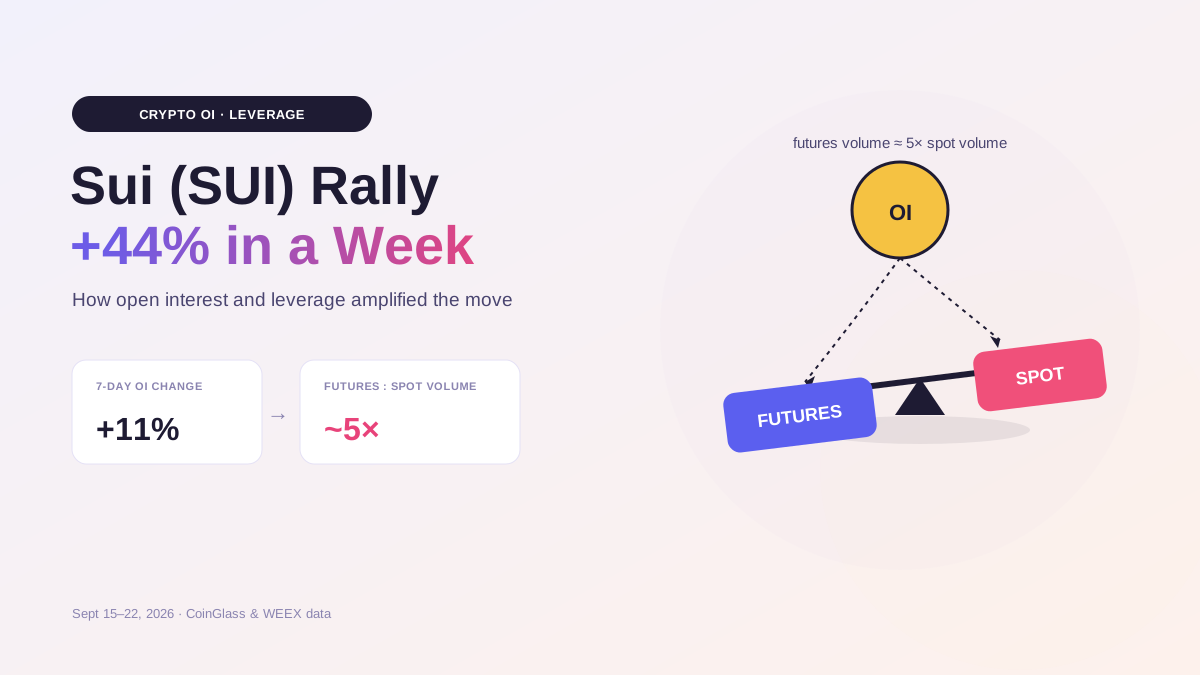
Why Did Sui (SUI) Crypto Price Jump 44%? Crypto OI and Leverage Explain the Rally
See why Sui (SUI) jumped 44%, how crypto OI and leverage amplified the rally, what the pullback means, and how to trade SUI on WEEX.

CFTC Chair Calls for "Mass Tokenization"! Wall Street Faces Three Barriers to Full On-Chain Adoption

Is the 1 Billion POL Burn Just a Joke?
WEEX Exclusive:Bitcoin Pulls Back From $87,000| WEEX TradFi Daily Brief (September 24, 2026)

Bitcoin Pulls Back From $87,000| WEEX TradFi Daily Brief (September 24, 2026)
Bitcoin pulled back from about $87,000 to about $84,000, with Ethereum near $2,680. S&P Global PMI on September 23 ET far exceeded forecasts. The 10-year yield broke above 5.00%, while the 5-year and 30-year touched highs last seen in 2007 and 2004. The S&P 500 and Nasdaq slipped. Energy moved with oil and crypto-treasury stocks followed bitcoin lower. Investors await earnings from COST, BB, and others.
OKX Star Points Out THORChain TSS + Validator Model Lacks Decentralization
Payward, the parent company of Kraken, invests billions in financial infrastructure
Bloomberg analyst warns 5% U.S. 10-year yield may reduce Bitcoin appeal
Shielded Bitcoin: the proposal that aims to bring privacy without changing BTC's code
What is CBDC? Governments Push for Development of Central Bank Digital Currencies
Backpack CEO Plans to Bring the Entire Stock Market to Solana


