
Aave borrowers faced up to 36% APR while a freeze blocked fresh collateral

 Prefer us on Google


Borrowers in Aave's frozen reserves kept paying interest while the restrictions prevented fresh deposits, including the extra collateral they might normally supply to protect a loan. Suppliers were still able to request their money back, provided enough tokens were available, so withdrawals could make borrowing more expensive even though new borrowing was blocked in those reserves.
That left Aave with a rate mechanism whose deposit incentive couldn't work in frozen reserves. More expensive borrowing encourages people to repay and offers better returns to anyone willing to lend, but the freeze prevented that second group from putting money in. Cutting rates could give borrowers some relief, while doing nothing by itself to return the tokens suppliers wanted to withdraw.
The restrictions were introduced during the Oct. 29 Binance hot-wallet incident, and the affected reserves had reopened by Oct. 31.
LlamaRisk's recommendations to reduce borrowing rates temporarily, then restore their earlier settings, explain how protecting a lending market can leave its existing users needing different things from the same pool of money.
Why your Aave loan kept running
Someone using Aave can supply crypto as collateral and borrow another token against it, obtaining funds without selling the original holding. If you want dollars while keeping your Ethereum, for example, you can borrow a dollar-linked token such as USDC.
Those borrowed tokens come from other users who supplied them to Aave's lending contracts, the blockchain programs that handle the transactions. Suppliers earn interest while borrowers owe it. However, the same person can be both a supplier and a borrower with different assets. Supplying ETH as security for a USDC loan doesn't mean you've supplied the USDC that someone else wants to withdraw.
During the Binance hack, a wallet linked to exploiters had already supplied about $60 million of USDT and borrowed 19,762 WETH, according to LlamaRisk's account. The provider described the position as overcollateralized, meaning its collateral exceeded its debt, and said it was subject to normal liquidation. The restrictions were intended to limit further use of Aave during an external compromise.
Freezing the affected reserves stopped new supply and borrowing while repayments, withdrawals, and liquidations were still enabled. Therefore, existing debt continued to accumulate interest, but borrowers couldn't supply extra collateral into those frozen reserves.
Repayment could still reduce the debt, provided the borrower could obtain the necessary tokens. If you've borrowed USDC against ETH, repaying requires USDC, while adding more ETH would ordinarily let you support the debt without reducing it. Losing the second option narrows how you can manage the position, especially if the collateral's market price is falling at the same time.
Under Aave's liquidation rules, the health factor divides collateral value, adjusted by its liquidation threshold, by total debt. Below one, the position becomes eligible for liquidation, allowing another participant to repay debt and receive collateral plus a bonus. Interest adds to the debt side of that calculation even if the collateral price doesn't move.
Better returns don't put tokens in your wallet
However, suppliers depended on a different balance: how much of the token they wanted was actually available to withdraw. In a simplified pool with 100 USDC supplied and 90 USDC borrowed, only 10 USDC is immediately unborrowed, even if every loan has ample collateral behind it. Collateral supporting those loans doesn't turn into additional USDC just because a supplier wants to leave.
If suppliers withdraw five of those available tokens while the debt stays at 90 USDC, the pool now has 95 USDC supplied and only five available. The borrowed share has increased from 90% to about 94.7%, despite nobody taking out another loan. This is what utilization measures, and it explains how withdrawals can make a frozen market more expensive for borrowers who haven't touched their accounts.
Aave's rate formula charges more as utilization increases, with a stronger response beyond a configured threshold. Its upper section is controlled by a parameter called Slope2. Normally, higher borrowing costs encourage repayment while better supplier returns can attract fresh funds, and both can replenish the tokens available for withdrawal. During the freeze, new deposits were prohibited, leaving repayment as the available channel among those two responses.
That's why LlamaRisk recommended reducing that upper rate response. Its rationale attributed utilization of 92% to 100% in major stablecoin reserves to supplier withdrawals during the freeze, with annual borrowing rates of 10% to 36% under the settings then in place. Those were annualized rates, so a few hours at 36% didn't add 36% to someone's debt.
To put the scale in dollars, a hypothetical $10,000 loan at a constant 36% annual percentage rate would accrue roughly $9.86 in one day, versus about $2.74 at 10%, ignoring compounding and fees.
Reducing that bill also reduces the interest available to support supplier returns. Suppliers may prefer more interest, but someone trying to withdraw needs the underlying token, and Aave permits withdrawals only against available liquidity, subject to the account's collateral requirements. Even an attractive quoted yield can't pay for something outside the protocol until the supplier can retrieve the tokens.
How reopening changed the rate incentives
Once fresh supply was possible again, a higher rate could once more attract deposits, giving LlamaRisk a reason to recommend restoring the earlier upper slopes on Oct. 31. Its published comparison held each reserve's utilization constant to show what the proposed settings would do, rather than recording what borrowers subsequently paid. Restoring Aave rates had uneven modeled costs for USDC borrowers
Borrowing APR for five Aave V3 USDC reserves at each reserve's Oct. 31, 2026, 18:05 UTC utilization. Compares temporary settings with proposed restored settings, holding utilization fixed within each reserve. These are LlamaRisk's published modeled rates, not a before-and-after time series or realized interest bills. Values retain source rounding; no interpolation.{#cs-chart-1-description}
Retry chart
View the data table below.
Chart by CryptoSlate
Source: LlamaRisk, Oct. 31, 2026, Aave V3 comparison at 18:05 UTC
View dataHide data
| Category | Temporary settings: borrowing APR | Proposed restored settings: borrowing APR | | Ethereum Core | 4.5% | 4.5% | | Monad | 4.97% | 4.97% | | Optimism | 6.61% | 8.35% | | Base | 7.69% | 10.35% |
| Avalanche | 8.75% | 12.24% |
|---|---|---|
| [Restoring Aave rates had uneven modeled costs for USDC borrowers] |
Core USDC was at its 94% threshold, where restoring the upper slope produced no immediate increase in the modeled rate. Base USDC was beyond its own threshold, so the same kind of intervention produced a much higher modeled cost. The reserve containing billions of dollars could show no immediate rate difference while the smaller reserve became more expensive, because each had different utilization and settings.
CryptoSlate's reopening coverage documented the continuing constraints. Permission to deposit or borrow, the collateral accepted for a loan, and the funds available for withdrawal determine different parts of what a user can do.
Getting more tokens back into a reserve also depends on what people actually do with those permissions. Fresh deposits and repayments add available tokens, while new borrowing and supplier withdrawals consume them.
Borrowers trying to preserve collateral consequently have a reason to want slower debt accrual, while suppliers trying to exit have a reason to want stronger repayment incentives.
-- Price
This content is provided for general informational purposes only and doesn't constitute financial, investment, legal, or tax advice. Any events, rewards, online promotions, or related information mentioned herein should not be considered a recommendation, solicitation, or invitation to purchase, sell, trade, or otherwise deal in any crypto assets. Crypto assets are highly volatile and may result in loss. The availability of WEEX services, products, and related events may vary by region. You are responsible for ensuring that your participation is in accordance with applicable local laws and regulations.
You may also like

XRPL lending protocol gains validator support as vault vote advances

US card debt hits $1.29 trillion as Bitcoin loans expose a collateral divide

CryptoQuant: Bitcoin Analyst Sentiment Significantly Bearish, Index Drops to -1.8σ

How Much CPO Demand Will NVIDIA's Rubin Ultra Generate? Bernstein: Optical Value of Single Pod Increases Fivefold

Pump.fun Data Review: Why the Current Meme Market Has Become a 'Harvesting Game'?

As Protocols Move Back to the Mainnet, How Does Ethereum's Value Logic Change?

As Whales Embrace ETFs, Security Anxiety in the Crypto World is Spreading
How Much Revenue Can Anthropic Generate for Every $1 Spent on Computing Power?

WEEX 11.11 Shopping Fest: Buy BTC and Unlock Up to 888 USDT in Rewards

Bitget UEX Daily Report | Inflation Surprises and Pressures US Stocks; Nvidia Falls Over 5%; Gold Drops Below $4100 (November 11, 2026)

How Much Net Buying Power Will ETH Lose When Bitmine Stops Buying?
LlamaRisk Proposes to Narrow Aave V3 Core Collateral Asset Range, Involving $1.33 Billion in Collateral

Algorithmic Trading and Cryptocurrencies: How Do Robots React to Volatility?

Cardano’s police evidence system could bring 1.5 million annual transactions

Confidence at Zero! Goldman Sachs Interprets Hedge Fund Positions: 'Surrender Liquidation', Largest Loss Since the Pandemic

47% Top Tax Rate Approaches: Seven Tax Reduction Strategies for Australian Crypto Investors
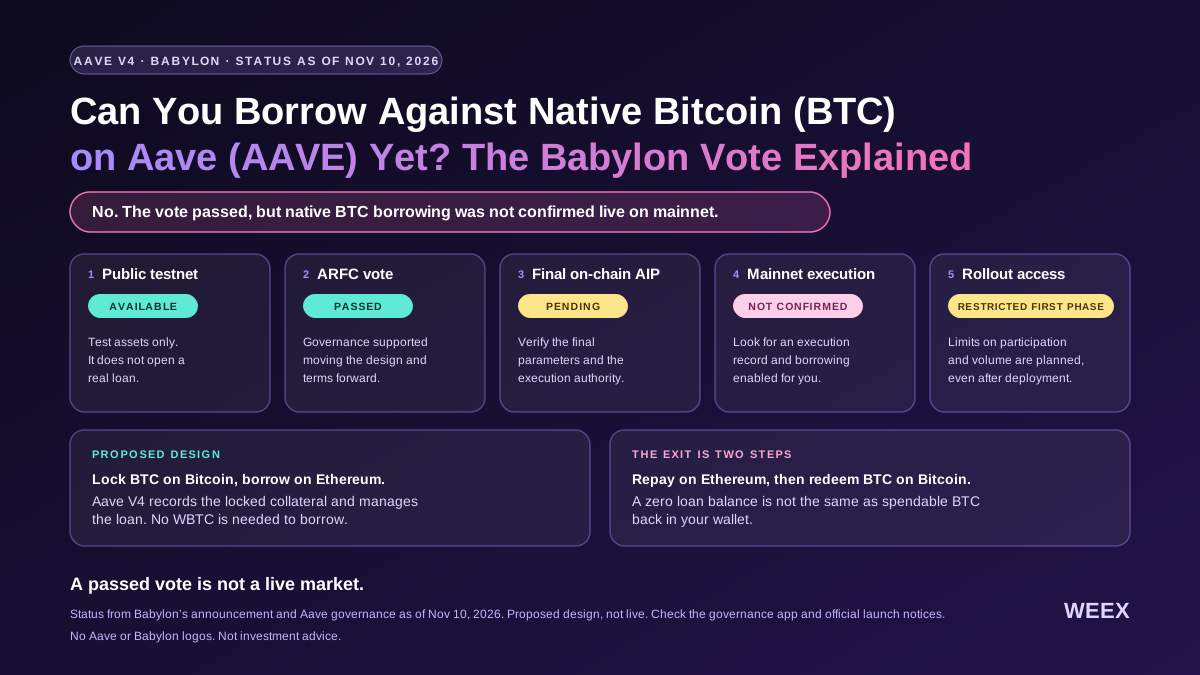
Can You Borrow Against Native Bitcoin (BTC) on Aave (AAVE) Yet? The Babylon Vote Explained
Can you borrow against native Bitcoin on Aave yet? See what the Babylon vote approved, what still needs to launch, and how BTC liquidation would work.

PIEVERSE Price Up Nearly 80% in a Week: Futures Activity, the November 14 Unlock and What Is Confirmed
PIEVERSE rose about 79% in seven days with futures volume far above spot. See what is confirmed about the November 14 unlock and the WEEX Lucky Eggs campaign.

Hong Kong Approves Crypto Asset Reporting Rules - Fintech World

NVDA Stock Falls 4.3% After Board Opens Investigation: What Is Confirmed and What Is Not
NVDA closed at $178.67 on November 9, 2026, down about 4.3%, after Nvidia’s board confirmed an independent investigation. Other claims come from media reports. WEEX’s Lucky Eggs campaign runs until November 25.

Chainalysis Report: Why Did Western Europe Withstand the Global Crypto Market Chill?

Four Security Strategies from the Wallet Theft Incident

Global Outage: Your Cryptos Are Not Disappearing

Did Strategy buy Bitcoin? Saylor reignites speculation

A New Chapter in the History of Rug Pulls in Crypto

From Binance Incubator to Nasdaq: Injective's Eight Years

tBTC Cross-Chain Bridge Resumes On-Chain Operations, Threshold Network Confirms Adequate Reserves
FinCEN Withdraws Proposed Crypto Travel Rule Expansion in Separate November Move

Finnish Startup Uses Heat from Bitcoin Miners to Heat 30 Homes

Analysis: The Logic of BTC's Periodic Recovery Remains Unshaken, Losses and Panic Have Been Fully Released
XRPL lending protocol gains validator support as vault vote advances
US card debt hits $1.29 trillion as Bitcoin loans expose a collateral divide
CryptoQuant: Bitcoin Analyst Sentiment Significantly Bearish, Index Drops to -1.8σ
How Much CPO Demand Will NVIDIA's Rubin Ultra Generate? Bernstein: Optical Value of Single Pod Increases Fivefold
Pump.fun Data Review: Why the Current Meme Market Has Become a 'Harvesting Game'?
As Protocols Move Back to the Mainnet, How Does Ethereum's Value Logic Change?
Latest articles


Latest coin listings on WEEX


