
67% of the wealthy own digital assets, but the crypto adoption gap remains huge

 Prefer us on Google


A new study by Nexo on 1,000 wealthy investors in the United States, the United Kingdom, and Argentina highlights a significant gap in crypto adoption between those who own digital assets and those who have truly integrated them into their financial strategy.
Summary
- Key points
- High crypto ownership among wealthy investors
- Scope of the global survey and profile of participants
- Country-specific ownership rates
- The gap in crypto integration in wealth management
- Definition and average score of the Crypto Integration Index
- Low rate of structural integration
- Differences between countries in integration
- Factors influencing crypto integration
- The role of risk perception versus practical factors
- Operational barriers among structurally integrated investors
- Implications for regulatory clarity and market adoption
- FAQ
- What percentage of wealthy investors own crypto according to Nexo's report?
- How many investors have deeply integrated crypto into their financial planning?
- What factors most influence the level of crypto integration among wealthy investors?
- What are the main barriers for structurally integrated investors with crypto?
Key points
- 67% of the wealthy investors surveyed own crypto assets, but only 4.7% have integrated them structurally into their financial planning.
- The average score of the Crypto Integration Index among participants is 4.83 out of 10.
- 42.6% of respondents own crypto but have not included it in a broader financial strategy.
- Argentina has the highest ownership rate (74%) but the lowest integration score (4.62); the United States records the opposite, with 62.3% ownership and the highest score, 5.07.
- Among structurally integrated investors, the main barriers are security (36%), high fees (34%), and platform complexity (28%).
The report, titled "The Future of Digital Wealth 2026" and published on September 23, describes a market where owning digital assets is now the norm among high net worth individuals. However, transforming that ownership into a true strategy built around crypto remains an exception, not the rule.
High crypto ownership among wealthy investors
Two out of three wealthy investors already have digital assets in their portfolios, according to data collected by Nexo. This figure indicates how familiar crypto has become for those managing substantial wealth, but it says little about how they are actually used.
Scope of the global survey and profile of participants
The survey was conducted between February and March through the research platform Attest, on a sample of 1,000 investors. To participate, respondents were required to have at least $100,000 in liquid assets in the United States and the United Kingdom, or $40,000 in Argentina: thresholds that, according to Nexo, roughly correspond to the top 25-30% of wealthiest investors in each market.
Country-specific ownership rates
Argentina leads the ownership ranking with 74% of respondents holding crypto. The United Kingdom follows with 65%, while the United States closes with 62.3%, the lowest rate among the three analyzed markets.
The gap in crypto integration in wealth management
The numbers on ownership tell only half the story. To measure how deeply crypto is rooted in financial choices, Nexo has built a dedicated indicator that weighs five factors equally: allocation size, duration of ownership, integration into retirement planning, replacement of traditional assets, and risk perception.
Definition and average score of the Crypto Integration Index
The average score recorded among all participants is 4.83 out of 10. An investor close to this average typically holds a relatively small crypto position, maintained for a short period and never included in a retirement plan.
Low Rate of Structural Integration
Only 4.7% of participants achieved a score of 7 or higher, the threshold that Nexo defines as "structurally integrated." An additional 42.6% own crypto but have not yet incorporated it into broader financial planning: a significant market segment that remains, in fact, inactive from a strategic standpoint.
Despite this, long-term confidence is not lacking: just under 20% of respondents expect crypto to become the main source of growth for their personal wealth in the next decade, surpassing salaries, stocks, and real estate.
Differences Between Countries in Integration
Here the picture flips compared to ownership data. Argentina, which leads in ownership, records the lowest integration score at 4.62. The United States, last in ownership, achieves the highest score at 5.07. The United Kingdom is positioned in the middle on both fronts, with 65% ownership and a CII of 4.75.
-- Price
Factors Influencing Crypto Integration
Why does this gap in crypto adoption matter? Because it contradicts the widespread idea that fear of risk is the main brake on the spread of digital assets among high net worth individuals. Nexo's data tells a different story.
Role of Risk Perception Compared to Practical Factors
Risk perception explains only 13.6% of the variation in integration scores. The truly decisive factor is practical: elements such as the replacement of traditional assets and retirement planning alone account for 54.2% of the variation.
Nexo analyst Iliya Kalchev summarized the data as follows: "The perception of risk is used to separate investors who have built real wealth with crypto from those who have not. What really divides them is whether they have replaced crypto with a traditional asset and included it in retirement planning."
Operational Barriers Among Structurally Integrated Investors
Among the 4.7% of investors classified as structurally integrated, the cited obstacles are operational in nature. Security concerns top the list at 36%, followed by high fees at 34% and platform complexity at 28%.
Neil Steinhardt, Chief Operating Officer of Nexo US, commented: "Once the phase of risk perception is overcome, security, fees, and ease of use of platforms remain. This is the gap between owning crypto and truly building wealth with it."
The data on fees deserves attention: at 34%, it is the second most cited barrier among the most advanced users, those who theoretically have already overcome the initial hurdles of adoption. This means that the problem is not convincing skeptics, but removing friction for those who have already chosen to invest.
Implications for Regulatory Clarity and Market Adoption
The 42.6% of wealthy investors who own crypto without having integrated it represent a huge latent market. The 54.2% share, that is, the part of variation in integration explained by practical factors such as retirement planning and asset replacement, suggests that greater regulatory clarity on crypto in retirement accounts, on the tax treatment of staking income, and on standardized reporting could do more to deepen adoption than market performance alone.
There are still significant demographic differences: the 35-44 age group shows the highest pension integration, with 28% considering crypto a central asset for retirement. Among those aged 18 to 25, over 90% own crypto, but only 2% have an investment horizon longer than ten years: high conviction, almost no integration.
FAQ
What percentage of wealthy investors own crypto according to the Nexo report?
67% of the wealthy investors surveyed own crypto assets.
How many investors have deeply integrated crypto into their financial planning?
Only 4.7% of participants scored 7 or higher on the Crypto Integration Index, the level indicating deep integration.
What factors most influence the level of crypto integration among wealthy investors?
Practical factors, such as the replacement of traditional assets and retirement planning, explain 54.2% of the variation in integration, while risk perception explains only 13.6%.
What are the main barriers for structurally integrated investors with crypto?
Concerns about security (36%), high fees (34%), and the complexity of platforms (28%) are the most cited barriers.
Content created with the assistance of artificial intelligence and human editorial review.
This content is provided for general informational purposes only and doesn't constitute financial, investment, legal, or tax advice. Any events, rewards, online promotions, or related information mentioned herein should not be considered a recommendation, solicitation, or invitation to purchase, sell, trade, or otherwise deal in any crypto assets. Crypto assets are highly volatile and may result in loss. The availability of WEEX services, products, and related events may vary by region. You are responsible for ensuring that your participation is in accordance with applicable local laws and regulations.
You may also like

XRPL lending protocol gains validator support as vault vote advances

US card debt hits $1.29 trillion as Bitcoin loans expose a collateral divide

CryptoQuant: Bitcoin Analyst Sentiment Significantly Bearish, Index Drops to -1.8σ

How Much CPO Demand Will NVIDIA's Rubin Ultra Generate? Bernstein: Optical Value of Single Pod Increases Fivefold

Pump.fun Data Review: Why the Current Meme Market Has Become a 'Harvesting Game'?

As Protocols Move Back to the Mainnet, How Does Ethereum's Value Logic Change?

As Whales Embrace ETFs, Security Anxiety in the Crypto World is Spreading
How Much Revenue Can Anthropic Generate for Every $1 Spent on Computing Power?

WEEX 11.11 Shopping Fest: Buy BTC and Unlock Up to 888 USDT in Rewards

Bitget UEX Daily Report | Inflation Surprises and Pressures US Stocks; Nvidia Falls Over 5%; Gold Drops Below $4100 (November 11, 2026)

How Much Net Buying Power Will ETH Lose When Bitmine Stops Buying?
LlamaRisk Proposes to Narrow Aave V3 Core Collateral Asset Range, Involving $1.33 Billion in Collateral

Algorithmic Trading and Cryptocurrencies: How Do Robots React to Volatility?

Cardano’s police evidence system could bring 1.5 million annual transactions

Confidence at Zero! Goldman Sachs Interprets Hedge Fund Positions: 'Surrender Liquidation', Largest Loss Since the Pandemic

47% Top Tax Rate Approaches: Seven Tax Reduction Strategies for Australian Crypto Investors
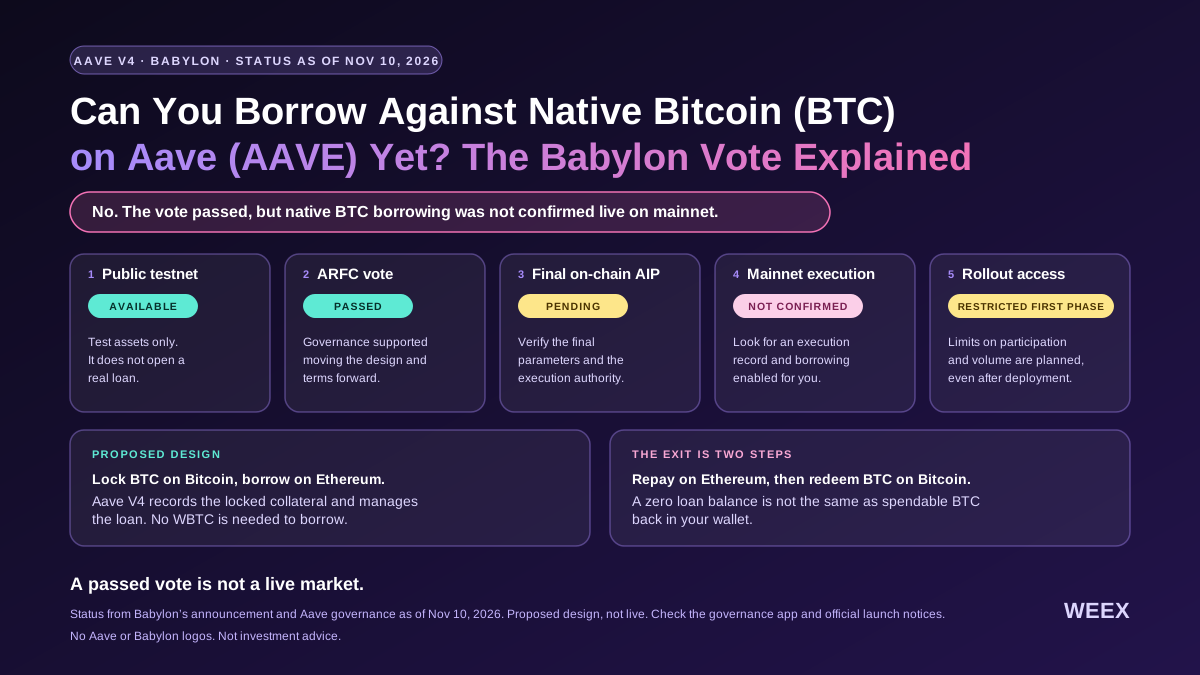
Can You Borrow Against Native Bitcoin (BTC) on Aave (AAVE) Yet? The Babylon Vote Explained
Can you borrow against native Bitcoin on Aave yet? See what the Babylon vote approved, what still needs to launch, and how BTC liquidation would work.

PIEVERSE Price Up Nearly 80% in a Week: Futures Activity, the November 14 Unlock and What Is Confirmed
PIEVERSE rose about 79% in seven days with futures volume far above spot. See what is confirmed about the November 14 unlock and the WEEX Lucky Eggs campaign.
Hong Kong Approves Crypto Asset Reporting Rules - Fintech World

NVDA Stock Falls 4.3% After Board Opens Investigation: What Is Confirmed and What Is Not
NVDA closed at $178.67 on November 9, 2026, down about 4.3%, after Nvidia’s board confirmed an independent investigation. Other claims come from media reports. WEEX’s Lucky Eggs campaign runs until November 25.

Chainalysis Report: Why Did Western Europe Withstand the Global Crypto Market Chill?

Four Security Strategies from the Wallet Theft Incident

Global Outage: Your Cryptos Are Not Disappearing

Did Strategy buy Bitcoin? Saylor reignites speculation

A New Chapter in the History of Rug Pulls in Crypto

From Binance Incubator to Nasdaq: Injective's Eight Years

tBTC Cross-Chain Bridge Resumes On-Chain Operations, Threshold Network Confirms Adequate Reserves
FinCEN Withdraws Proposed Crypto Travel Rule Expansion in Separate November Move

Finnish Startup Uses Heat from Bitcoin Miners to Heat 30 Homes

Analysis: The Logic of BTC's Periodic Recovery Remains Unshaken, Losses and Panic Have Been Fully Released
XRPL lending protocol gains validator support as vault vote advances
US card debt hits $1.29 trillion as Bitcoin loans expose a collateral divide
CryptoQuant: Bitcoin Analyst Sentiment Significantly Bearish, Index Drops to -1.8σ
How Much CPO Demand Will NVIDIA's Rubin Ultra Generate? Bernstein: Optical Value of Single Pod Increases Fivefold
Pump.fun Data Review: Why the Current Meme Market Has Become a 'Harvesting Game'?
As Protocols Move Back to the Mainnet, How Does Ethereum's Value Logic Change?
Latest articles


Latest coin listings on WEEX


