
WEEX Grid Trading: When a Grid Strategy Works and When It Fails

 Prefer us on Google


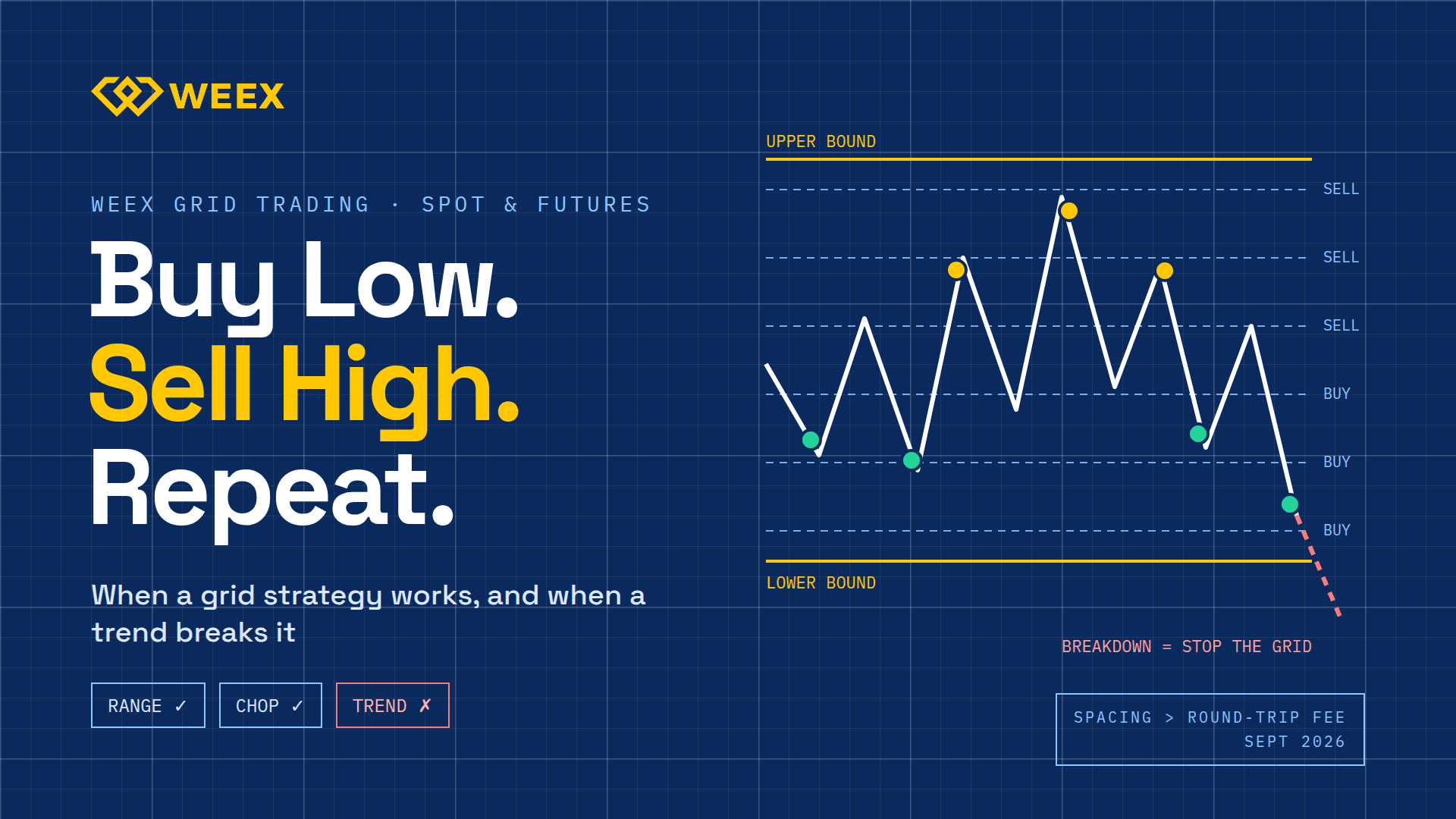
WEEX grid trading means placing a ladder of buy orders below the market and sell orders above it, so every swing inside a price range completes a small buy-low, sell-high cycle. On WEEX you build a grid from limit orders on spot or futures, or run it automatically through the WEEX OpenAPI. It works in sideways, choppy markets and does badly in strong trends. This guide covers how to space a grid so fees don't eat it, which market conditions suit it, and where it breaks.
How WEEX Grid Trading Works
A grid has four inputs:
- Range: the lower and upper price boundaries you expect the market to stay within.
- Grid count: how many price levels divide that range.
- Spacing: the gap between levels, which is also the gross profit per completed cycle.
- Size per level: how much you buy or sell at each step.
When price drops to a level, the buy order fills and a sell order is placed one level higher. When price rises to that sell, the cycle closes and a new buy goes back one level lower. The strategy doesn't try to predict direction. It gets paid for back-and-forth movement.
On WEEX, a grid can be built three ways:
- Manual spot ladder. Place resting limit buys and sells on a spot pair and replace them as they fill. This is the simplest version and needs no code.
- Futures grid with low leverage. The same ladder on a USDT-margined perpetual, which lets you run a neutral or short-biased grid. It also brings funding payments and liquidation risk into the picture.
- API-driven grid. A script connected to WEEX's Spot or Futures API places and replaces orders automatically. This is how most active grids run, because re-placing orders by hand stops being practical once you have more than a dozen levels.
Grid Spacing and Fees: The Math That Decides Profit
Every completed grid cycle is two trades, a buy and a sell, so your spacing has to beat the fees on both. As of September 2026, WEEX's published rates give very different floors for spot and futures:
- Spot, maker on both sides: WEEX spot charges 0% maker, so a cycle of two resting limit orders pays no trading fee. Any spacing above zero is gross profit, which makes spot a good fit for tight grids.
- Futures, maker on both sides: 0.02% + 0.02% = 0.04% of notional per cycle. A 0.3% spacing keeps about 0.26%.
- Futures, taker on both sides: 0.08% + 0.08% = 0.16% per cycle. This happens when orders cross the book instead of resting on it. A 0.3% spacing then keeps only 0.14%, so fees take more than half.
The practical rule: make sure grid orders rest on the book as makers. If you run the grid through the API, use post-only (maker-only) orders. A normal limit order priced through the market fills as a taker and pays the higher rate. WEEX's full rate formula is in its futures fee calculation guide.
A worked example (hypothetical numbers). Say ETH has traded between $3,000 and $3,600 for three weeks. A 12-level spot grid over that range spaces levels $50 apart, about 1.4% to 1.7% per cycle depending on where in the range it fills. With 0% spot maker fees, each completed cycle keeps all of that spacing. The risk is not the fee. The risk is ETH closing below $3,000 with every buy filled and none of the sells.
Where WEEX Grid Trading Works Best
Grid trading suits markets where price keeps returning to the same zone:
- Consolidation after a big move. After a sharp rally or sell-off, majors like BTC and ETH often spend days or weeks in a range while the market absorbs the move. Those are good conditions for a grid.
- Choppy weeks with a lot of intraday swing. More swing within the range means more completed cycles. A range that barely moves hardly fills anything.
- Liquid pairs. Deep order books mean your resting orders fill near their intended price. Thin altcoin books can jump past several levels at once.
- Traders who can't watch screens. A grid follows its rules without second-guessing, which is useful if your main weakness is closing positions too early.
-- Price
When a Grid Strategy Fails
The same mechanics that collect small profits in a range pile up losses when price leaves it:
- Downtrend on a spot grid. Every buy fills and none of the sells do. You end up fully invested in a falling asset with unrealized losses much larger than the grid profits collected.
- Uptrend on a spot grid. Every sell fills and the grid ends up holding stablecoins while price keeps rising. You don't lose capital, but you give up the rally.
- Trend against a leveraged futures grid. This is the dangerous case. A long-biased futures grid in a breakdown keeps adding exposure as price falls, and with leverage that can end in liquidation rather than just a drawdown.
- News and event days. Rate decisions, large token unlocks and exchange headlines can push price straight through the range in one candle.
What experienced grid traders do: set a stop outside the range and stick to it, keep futures grids at low leverage on isolated margin, and treat a close outside the range as a signal to stop the grid, not to widen it. Widening the grid after a break is how a small loss becomes a large one.
How to Test a Grid on WEEX Before Going Live
- Choose one liquid pair and mark a range from recent support and resistance, not from a guess.
- Work out spacing so each cycle clears at least the maker round-trip fee, plus a buffer for occasional taker fills.
- Run the grid on WEEX demo futures on BTC/SUSDT for at least one or two weeks. Count completed cycles and see how the grid behaved on the worst day.
- Write down your exit rule: the price that ends the grid, and whether you close the inventory or keep it.
- Go live with a fraction of the planned size, then scale only if live fills match what the demo showed.
For a comparison of grid trading with DCA, trend-following and other automated approaches, WEEX's guide to crypto trading bot strategies for beginners explains where each fits.
FAQ
1. Is grid trading profitable on WEEX?
It can be in range-bound markets, especially on spot, where WEEX charges 0% maker fees. It loses money when price trends out of the range, so profit depends much more on choosing the right market conditions than on the grid settings.
2. What is the best grid spacing for crypto?
Spacing has to exceed the round-trip fee: nothing for maker-only spot cycles on WEEX, 0.04% for maker-only futures cycles, and 0.16% if both sides fill as takers. Beyond that, wider spacing completes fewer but more profitable cycles, and tighter spacing completes more but smaller ones.
3. Should I run a grid on spot or futures?
Spot grids have no liquidation risk, and on WEEX they cost no fees for maker fills, so they are the safer starting point. Futures grids let you run short or neutral grids but add funding payments, liquidation risk and higher fees.
The Bottom Line on WEEX Grid Trading
WEEX grid trading is a range strategy, not a prediction tool. It works when price oscillates inside a band you can define. It works best on spot with maker-only orders and on liquid pairs, and it needs a hard exit for the day the range breaks. Build it with limit orders or the WEEX OpenAPI, test it in demo, and treat a breakout as your signal to stop rather than a reason to add more levels.
Risk Warning
Grid trading does not remove market risk. Crypto assets are volatile, and a grid can lose part or all of its capital if price trends out of the chosen range. Spot grids can leave you holding a falling asset. Leveraged futures grids can be liquidated, and they pay funding while positions are open. Gaps, thin liquidity and taker fills can erase the expected profit per cycle, and API-driven grids add risks from software errors and connectivity. Test before trading live, and only commit funds you can afford to lose.
This content is provided for general informational purposes only and doesn't constitute financial, investment, legal, or tax advice. Any events, rewards, online promotions, or related information mentioned herein should not be considered a recommendation, solicitation, or invitation to purchase, sell, trade, or otherwise deal in any crypto assets. Crypto assets are highly volatile and may result in loss. The availability of WEEX services, products, and related events may vary by region. You are responsible for ensuring that your participation is in accordance with applicable local laws and regulations.
You may also like

Self-Custody Wallets: When a Crypto Transfer Must Be Reported to Brazil's Coaf
Ethereum Futures Trading: How to Size ETH Positions and Read PnL

What Is a White Label Crypto Exchange? A Complete Beginner's Guide
Is Hyperliquid Safe? Risks You Should Know Before You Trade

What a Blockchain Explorer Can and Cannot Tell You
How to Look Up a Wallet Address and Transaction History

How to Verify a Crypto Transaction With a Blockchain Explorer?
BTC Futures Trading on WEEX: Claim BTC Rewards Before Sep 25
What Is a Funding Rate? How Perpetual Futures Charge Longs and Shorts
Perpetual Futures for Beginners: Margin, Funding and Liquidation Explained
What the LUSD Attack Shows About DeFi Risk
What Is BONK? WEEX Spot and 1000BONK Futures Status and Risk Checks
What Is BRETT? WEEX Spot and Futures Status and Risk Checks
What Is FLOKI? WEEX Spot and 1000FLOKI Futures Status and Risk Checks

What Is WIF (dogwifhat)? WEEX Spot and Futures Status and Risk Checks

Who Is Attending TOKEN2049 Singapore 2026? Top Speakers, Exchanges and Exhibitors to Watch
USDC on Arc: What Circle's Mainnet Launch Changes for Holders
SpaceX Stock Futures: Where to Put Stops on a 115% Range
How to Trade Microsoft (MSFT) Stock Token with USDT on WEEX
How to Trade Apple (AAPL) Stock Token with USDT on WEEX
Crypto Futures Trading Explained: Leverage, Funding, Liquidation
Crypto Futures Trading: Leverage, Funding and Apple Perps
How to Trade Tesla (TSLA) Stock Token with USDT on WEEX: A Trading Guide for Beginers in 2026
How to Trade NVIDIA (NVDA) Stock Token with USDT on WEEX
How to Trade U.S. Stocks Without a Brokerage Account Using USDT
Nike Stock Price Prediction 2026: What the $50 Target Actually Requires to Happen

CLARITY Act Enters a Critical Window: What the September 15 Senate Vote Actually Means
What Are Spot Stock Tokens? How Synthetic Stock Trading Works
XST Coin Price Bounced 19% Off a New Low in Hours: Is This the Bottom or Just Noise?
What to Do After Buying USDT in Pakistan: Spot, Futures or Hold?
Self-Custody Wallets: When a Crypto Transfer Must Be Reported to Brazil's Coaf
Ethereum Futures Trading: How to Size ETH Positions and Read PnL
What Is a White Label Crypto Exchange? A Complete Beginner's Guide
Is Hyperliquid Safe? Risks You Should Know Before You Trade
What a Blockchain Explorer Can and Cannot Tell You
How to Look Up a Wallet Address and Transaction History



